

A decade under the sun
After 10 years of deployment, Minnkota members have gained experience (and a lot of data) from solar arrays across the system.
A decade of North Dakota weather has passed over the rows of solar panels on the south side of Fargo.
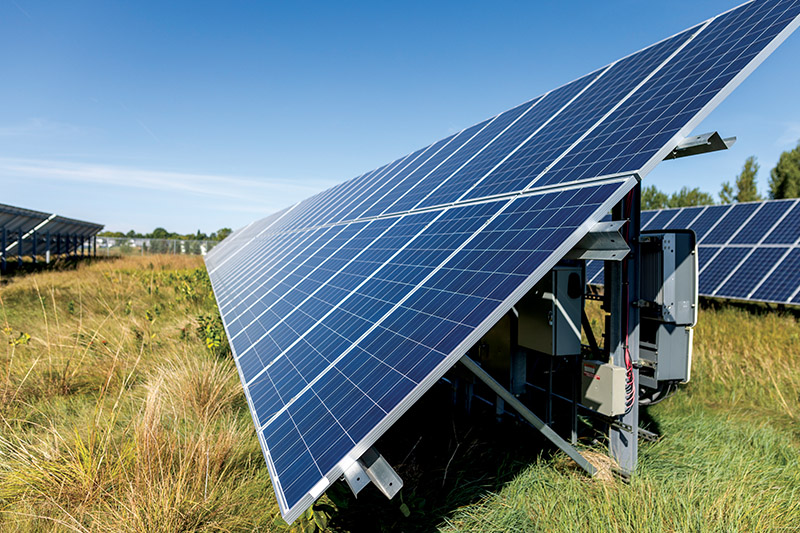
Blizzards have buried them. Summer sun has scorched their dark blue surfaces. Rain, wind and stretches of bitter cold have come and gone. Native prairie grasses have grown around the steel frames holding Cass County Electric Cooperative’s (CCEC) 101-kilowatt (kW) Prairie Sun Community Solar Garden.
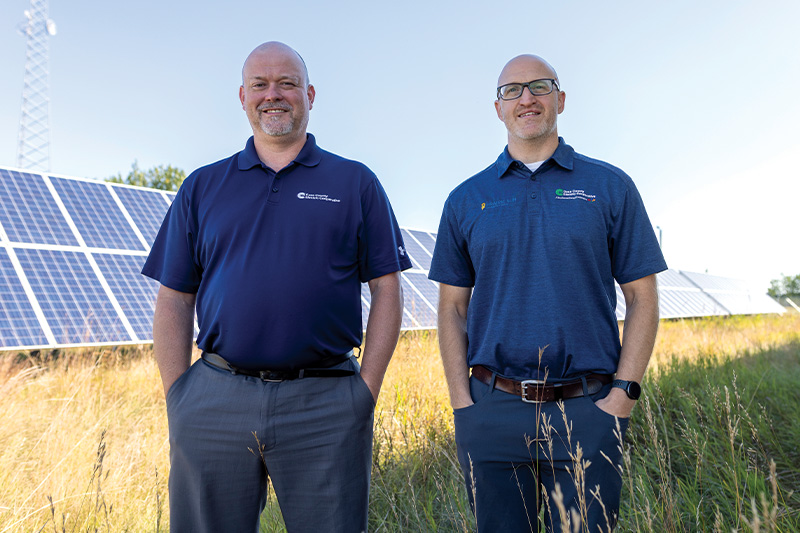
On a bright September morning, Troy Knutson and Chad Brousseau walked between the rows and considered what nearly 10 years of operation had taught them.
Quite a bit, as it turns out.
“We wanted to see what solar actually does here,” said Knutson, CCEC vice president of engineering and operations, who helped lead the project’s design. “We wanted to know how much it produces through the seasons, what kind of maintenance it actually requires and what parts of the system might need attention over time. There was really no substitute for having a system here and learning ourselves.”
That learning was a major reason Prairie Sun was built. The cooperative wanted to better understand a technology its members were increasingly asking about – not from Internet searches or a manufacturer’s projection, but from experience in its own backyard.
“We want to be the energy experts for our members,” said Brousseau, CCEC vice president of member and energy services. “If someone calls us with a question about solar, we want to be able to answer it with real-world experience and real-world data.”
An option for members
When CCEC developed Prairie Sun in 2016, members were expressing interest in solar generation, but putting panels on a home isn’t practical for everyone. Rental properties, roof orientation, insurance, maintenance or upfront cost can all create hurdles.
Community solar offered members with an opportunity to purchase the output of a panel or half panel at the centralized facility while CCEC handled the installation, operation and maintenance. Most participants originally bought into Prairie Sun for $700 and now receive a monthly bill credit based on the facility’s production. Approximately 80% of the project is subscribed.
“It takes a lot of the complications out of it for our members,” Knutson said. “You don’t have to figure out whether your roof is right for solar or worry about maintaining the equipment. We take care of that.”
Around the same time, cooperatives elsewhere in Minnkota’s membership were looking for answers to many of the same questions.
Beltrami Electric Cooperative developed its 80-kW Northern Solar community garden in Bemidji. Roseau Electric Cooperative installed a 10-kW demonstration array, while Red River Valley Co-op Power and North Star Electric Cooperative each developed 5-kW systems.
For Beltrami Electric, the project offered both a learning opportunity and an alternative for members surrounded by the thick tree cover common across northern Minnesota.
“We wanted that firsthand knowledge on solar so that we can help our members,” said Bob Gregg, Beltrami Electric business development manager. “We also wanted to provide an opportunity for those who wanted to install solar but didn’t have the right property to do so. We have some folks in heavily wooded areas where solar isn’t viable.”
What the numbers show
Nearly a decade of data has also created a clearer picture of what solar generation looks like this far north.
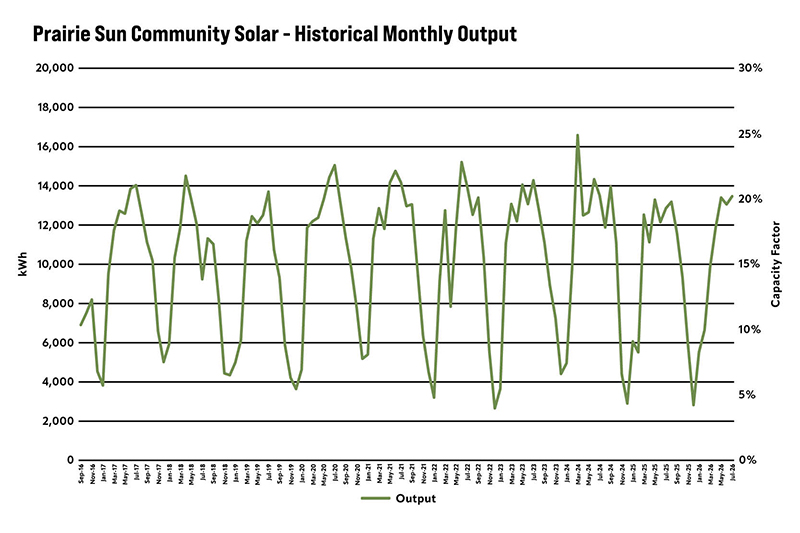
Prairie Sun has averaged an annual capacity factor of roughly 14%. Capacity factor is simply a comparison between how much electricity a resource actually produces and how much it could produce if it operated at full output every hour of the year. The other projects in the Minnkota system ranged from 10-15% during most years.
Not surprisingly, production changes dramatically with the seasons.
During strong summer months, Prairie Sun has reached capacity factors in the low-20% range. During the darkest and shortest days of winter, production can fall into the single digits, including around 5% in December.
“That’s one of the things we wanted to understand,” Knutson said. “Solar can produce well on a clear summer day, but when you look at the entire year, you get a much better picture of what you can realistically expect.”
Ten winters later
Perhaps surprisingly, North Dakota winter weather has not proven particularly hard on the panels themselves.
Snow generally slides or melts away without intervention. Crews have occasionally cleared panels following significant snowfall and extreme cold, but winter maintenance has otherwise been limited.
At Prairie Sun, the panels have proven durable. CCEC has even used infrared-equipped drones to inspect the array for potential problems. After nearly a decade, crews had not identified a failed panel.
Instead, the inverters have emerged as the common trouble spot across Minnkota member solar installations. Inverters convert the direct-current electricity produced by solar panels into the alternating current used by the electric grid. Every Minnkota member project has experienced inverter failures during its operating life.
“The inverter is probably the weakest link on the equipment side,” Knutson said. “That’s probably been one of the clearest maintenance lessons we’ve learned.”
And then there is the question that eventually follows almost every conversation about an energy investment: Does it pay for itself?
The answer requires patience. Prairie Sun received a $150,000 grant that significantly reduced its upfront cost. Even with that assistance, the original member participation model was designed around roughly a 20-year payback. Without grant funding, cooperative staff calculated that timeline would have stretched considerably longer.
That economic experience has become another important part of what the cooperatives can share with members. After nearly a decade of watching production, maintaining equipment and tracking costs, employees can speak about both the opportunities and limitations of solar in this region.
“We can just show them: Here’s what we’ve seen. Here’s what it produces. Here’s what we’ve had to maintain. Then they can make a more informed decision,” Brousseau said.
MAIN IMAGE: CCEC's Chad Brousseau and Troy Knutson walk the panels of their Prairie Sun Community Solar Garden. (Minnkota/Michael Hoeft)
...
5301 32nd Avenue South
Grand Forks, ND 58201
P: 701-795-4000
