

Rising to the challenge
Minnkota is uniting with several industry partners to responsibly power the new Applied Digital data center near Harwood, North Dakota.
Shaun Biller stood among a crowd of people with many titles – engineers, lineworkers, North Dakota state troopers, utility and construction project managers, even a pilot. In the distance was the steel framework of a large, nearly completed substation. In the opposite direction, a helicopter sat motionless, awaiting the task ahead.
As the general foreman for High Country Line Construction, Biller had a challenging job this Sunday morning. He was organizing an effort to pull a series of straw lines (or heavy wire ropes) through four 345-kilovolt (kV) transmission structures. Over a railroad. And a county highway. And a four-lane interstate. With a chopper.
“Today is a complex day as far as for a pull. It’s not bad, but we have a lot of moving parts this morning,” Biller explained to the safety meeting attendees. “Everything’s going to have to be coordinated and communicated.”
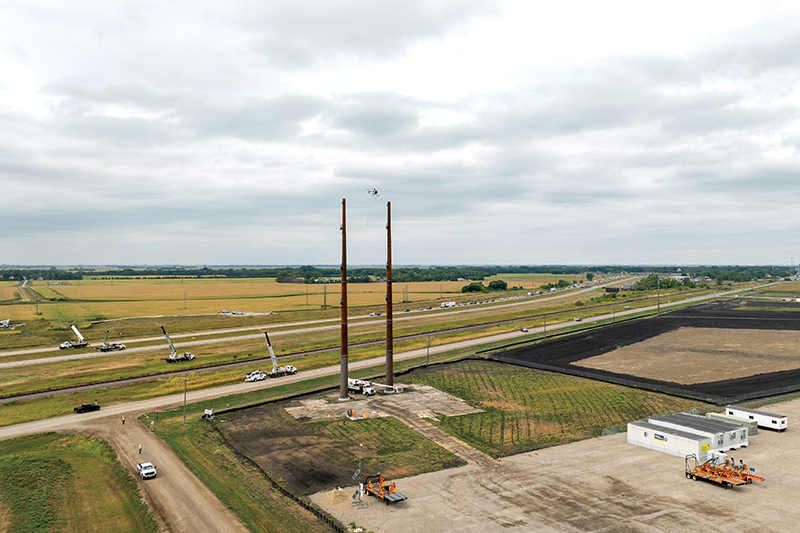
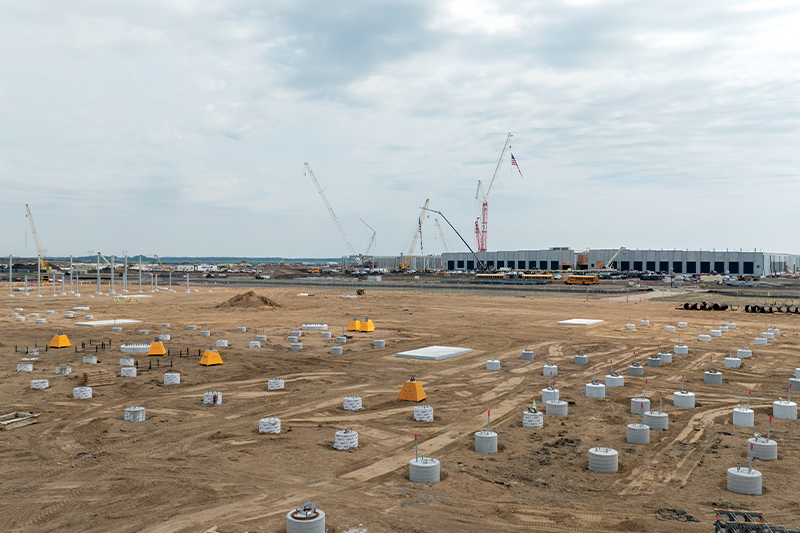
The complexity of this mission was reflective of the entire power project at hand. Minnkota Power Cooperative and several contracted partners were in the middle of one of the cooperative’s largest endeavors to date, building more than a mile and a half of 345-kV transmission line and a new substation to help power a 280-megawatt (MW) data center under construction near Harwood, North Dakota.
Applied Digital, now a business member of Cass County Electric Cooperative (CCEC), began construction of its Polaris Forge 2 AI Factory in September 2025 with a goal to partially energize the facility in 2026. All the new electric infrastructure would be paid for by Applied Digital, but the work itself would need to be done by the professionals. With a timeline that short and an ask that large, Minnkota and CCEC knew they would need to call in reinforcements.
Kara Laframboise, Minnkota’s project manager overseeing the planning, design and construction of the new transmission line and substation (called Agassiz), says Minnkota began looking for an engineering, procurement and construction (EPC) contractor and consultant right away. The co-op ultimately joined forces with the firm Burns & McDonnell, who gathered the rest of the contractors who would help complete the project in record time.
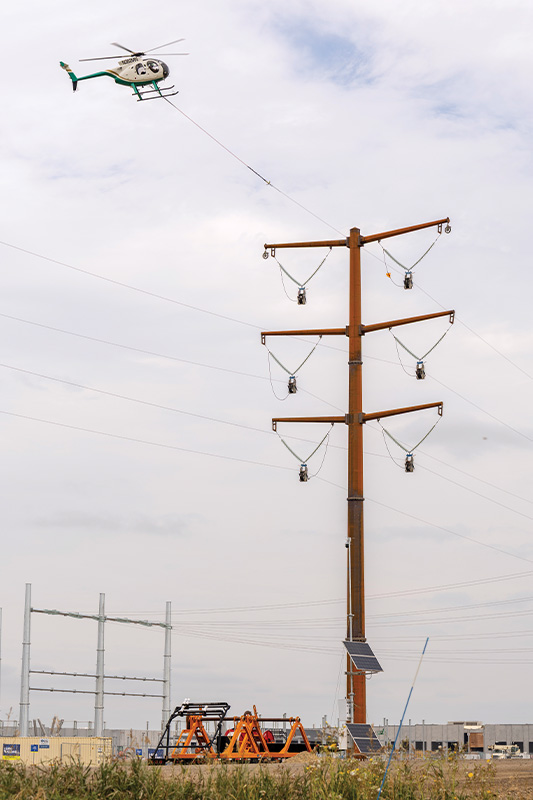
“Yes, these structures are bigger than what we would normally see in our system, but the basis around them is very similar to other work that we’ve done. What makes this project complex is the timeline, and just trying to meet the dates that are being asked of us by Applied Digital,” Laframboise said.
Large load opportunity
Serving a 280-MW load is not something Minnkota takes lightly. With cooperative values that put reliability, affordability and safety first, the leadership team knew well before Applied Digital that they would be facing growing requests of this kind. They began to develop a large load interconnection process for projects of 20 MW or more, through which applicants would agree to pay for not only the studies needed to ensure the project wouldn’t negatively impact Minnkota’s system and membership, but also for any new infrastructure necessary to serve the project.
When the large load interconnection process was ready in early 2025, Applied Digital was the first applicant in the queue, ready to pay for any system upgrades to serve their Harwood data center. After deep discussions with their respective boards – the voices of their member communities – Minnkota and CCEC got to work.
“We needed engineering studies on the transmission side and on the distribution side to find out if we could feasibly serve this load,” said CCEC President and CEO Paul Matthys. “That was step one. Step two was determining if we have the energy capacity to serve them. And the answer is we do. In many cases, the Minnkota system is long on energy.”
Through the early stages of exploring the data center project, Matthys and his co-op team engaged with their membership, explaining that CCEC had the capacity and energy to move forward with serving the data center. They also fielded many questions about how the data center would impact their electric rates. Rates would not go up as a result of the data center, Matthys told them. In fact, the data center could actually help stabilize rates by paying a larger portion of the fixed costs of upgrades in the area, which would be needed to keep power reliable in the quickly growing region.
“There’s a tremendous amount of upward pressure on rates already with inflation,” he said. “If we can leverage these data centers to help drive down those capital costs and drive down the pressure on rates for our members, that is a win-win for everybody.”
Nick Phillips, EVP of External Affairs for Applied Digital, said they were pleased to collaborate with Minnkota and CCEC and become a part of the community. “As part of this partnership, we’re investing $112 million to support enhancements to the regional electric infrastructure via the Agassiz substation,” he said. “This upgrade likely would have been needed in the future to support the regional grid, but we expedited the timeline at our expense because our tenants depend on highly reliable electric service for operating state-of-the-art data center infrastructure, 24/7.”
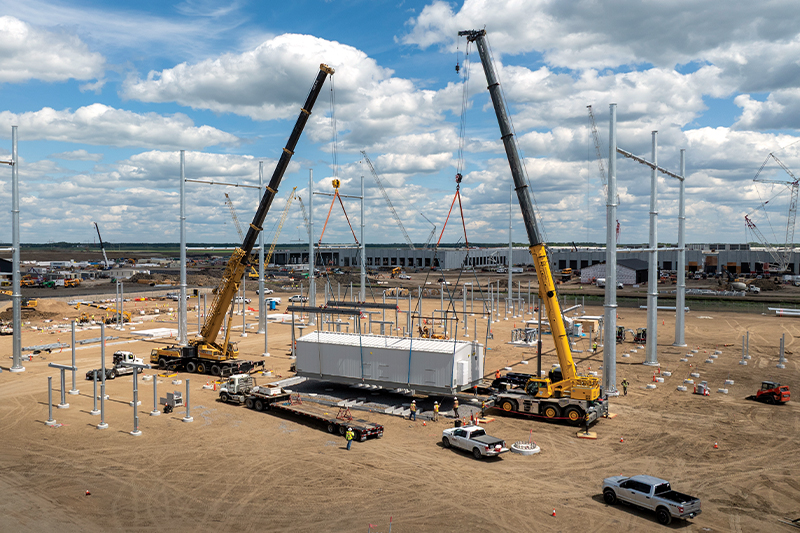
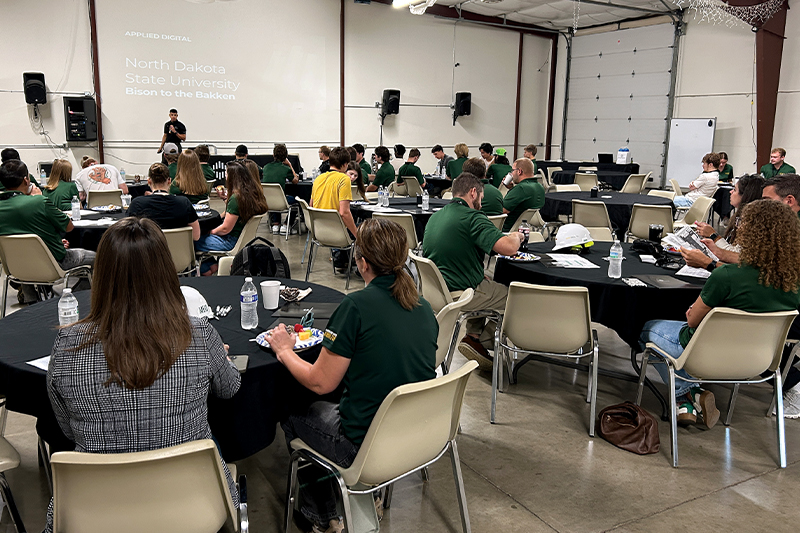
As work progresses on the new Agassiz substation, Minnkota, CCEC and Applied Digital have worked in partnership to answer lingering questions about the data center project. The companies have been involved in public meetings, site tours, informational panels, and other print and digital communications to tell the Polaris Forge 2 story.
“One of the great parts of the cooperative model is we are owned and governed by the members that we serve, so there’s a trust there, and we never want to do anything to jeopardize that,” Matthys said. “I’ve had several conversations with members who call and talk directly to me, to hear it from me. After we explain what we’re doing and why we’re doing it, they feel a lot more comfortable and they feel that trust in their cooperative.”
Coordination and communication
Kara Laframboise watched as the HLH Aviation helicopter delicately threaded the straw line through a pulley at the top of a 145-foot-tall transmission pole. In the next moment, the pilot pulled the line across Interstate 29, where Sunday traffic had been flagged to a temporary stop to ensure safety. In the following week, lineworkers would use the guiding line to pull the actual power conductor through the structures.
This day of work alone took the coordination of at least seven contracted companies and local entities. Laframboise says this level of collaboration has become common for the project.
“A large part of my role is really to help our EPC contractor keep everyone else on pace. I’m facilitating conversations, information flows, those sorts of things,” she said. “Originally, the goal was to try and burden Minnkota employees as little as possible, because we have so much other work that we’re trying to accomplish. Now, we’re at a point where we’re going to be taking this over at the end of the day, so we want to be involved a bit more so we can take it over with confidence.”
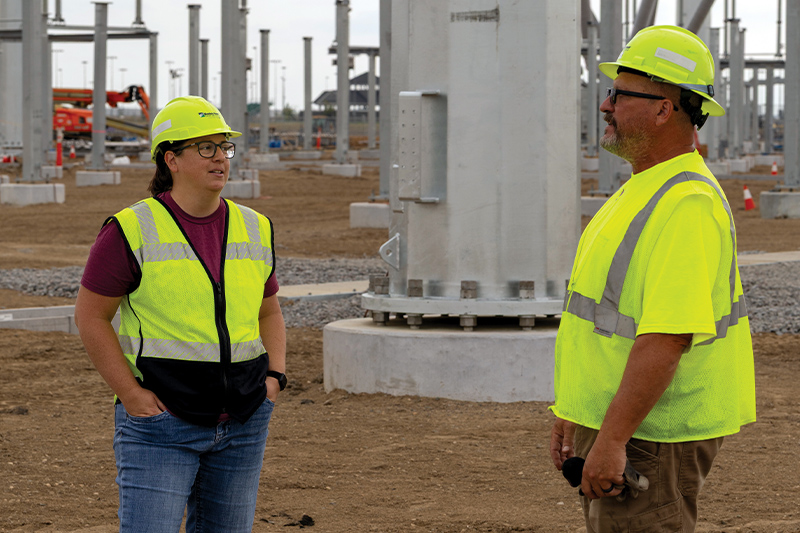
Once the Agassiz substation is ready for commissioning, Minnkota crews will step in to test and update relays and telecommunications equipment and perform initial energization procedures. Then, the substation will become the newest piece of the Minnkota grid.
An electrical engineer by training, Laframboise is used to being involved in the intricacies of substations across the Minnkota footprint. Although this project is her main priority now, there are still projects moving forward in all corners of the territory.
“We have our transmission rebuilds. We have our substation rebuilds. We couldn’t get distracted by this and let other projects fall off our radar,” said Kasey Borboa, Minnkota senior manager of Power Delivery Engineering. “We’re still doing great work on the rest of our system, and we’re still meeting those timelines and budgets.”
The challenges of providing power to Polaris Forge 2 have been great. Assessing and mitigating reliability risks, organizing the experts, securing substation materials, approving a flurry of designs – and doing it all at the speed-to-market pace expected by the AI sector.
“That’s the stuff you’re proud of. This was an insane timeline that we met,” Borboa said, adding that Minnkota’s typical substation timeline was condensed from three years to eight months for the data center. “This is new for us in terms of the EPC and how we’re managing projects. For Kara, this is her first full year as project manager, so she’s learning a lot on how to coordinate and communicate.”
With the final straw line pulled and interstate traffic back on track, Laframboise was able to check another mini miracle off the list and prepare for the next.
“I’m really happy I was chosen for this project,” she said. “I’m excited to see this substation get energized and see Minnkota hit this major milestone.”
MAIN IMAGE: Minnkota energy partners HLH Aviation and High Country Line Construction work as a team to string guiding lines for the Agassiz substation and transmission project near Harwood, North Dakota.
HARWOOD DATA CENTER FAQS
How big is the data center?
The Harwood data center will feature two purpose-built facilities totaling more than 1.8 million square feet.
How many people will work there?
Once fully operational, the site will employ more than 200 full-time personnel.
How much water will the data center use?
Applied Digital uses very little water in its processes (about as much as two average residential homes). The company uses an innovative, closed-loop water system that nearly eliminates the need for water consumption for cooling the equipment. This system ensures the data center operates sustainably without putting pressure on local water resources.
Will the facility be noisy?
The project uses sound mitigation strategies including sound barriers, setbacks and other tools to keep noise levels low. Computer equipment is housed inside precast concrete, sealed buildings, heat exchangers emit minimal noise, and backup generators are used only in emergencies or under maintenance at controlled times and are strictly regulated.
When will the data center be operational?
It will be partially operational by the end of 2026 and fully operational in 2027.
...
5301 32nd Avenue South
Grand Forks, ND 58201
P: 701-795-4000
