

A new algorithm for health care
Cass County Electric member Sanford Health is leveraging AI to enhance patient care and address workforce shortages.
Some doctors aren’t just doctors anymore. And that’s a good thing.
With new worlds of information revealing themselves every day, health care providers like Sanford Health’s Dr. Dave Newman aren’t just dipping their toes into the digital sphere. They’re cannonballing.
“I’m an endocrinologist by medical training. But I’m also an informaticist, which is like being a doctor tech bro,” Newman explained from his office in Fargo, North Dakota. “It’s using data science, computers, technology, all those things. That’s how I got into the role that I’m in now, as chief medical officer of virtual care here at Sanford.”
Sanford, a business member of Cass County Electric Cooperative, is one of several health systems across the nation embracing the digital evolution of patient care, including virtual care and artificial intelligence (AI) technologies. In 2021, Sanford received a gift of $350 million to develop a Virtual Care Center in Sioux Falls, South Dakota. The hub now provides more accessible medical support for patients in the rural areas of the Upper Midwest.

In Newman’s definition, virtual care includes any non-face-to-face care that leverages technology. “We perform virtual care visits and e-medicine visits, and we are expanding into virtual reality,” he said. “A lot of our artificial intelligence ideas run through our Virtual Care Center, and it’s really moving health care into the technology age.”
‘Literally changing people’s lives’
Sanford has been at the forefront of exploring AI processes that benefit both patients and providers. For example, they’ve created a large data science team to develop a predictive analytics program, which uses AI algorithms to predict certain diseases. Sanford can currently use patient data to predict eight conditions but expects to uncover more in the future.
“The one that we’ve had the most success with has been for chronic kidney disease,” Newman said. “We can look at your chart, your labs, your ethnicity, your family history, and we can predict if you’re going to develop chronic kidney disease and get that information to your primary care provider faster.”
Predictive analytics will soon also assist with colon cancer screenings. There currently aren’t enough doctors to perform all the rural colonoscopies that are needed, so the predictive analytics team can determine which patients may be best served by a less-invasive test.
Sanford also uses a virtual operating room to help surgeons walk through upcoming surgeries using virtual reality goggles, allowing them to look more deeply at the nerves and anatomy of any given body part before the patient is even prepped.

Newman also describes an AI-enabled fall prevention device now found in Sanford facilities. A camera placed on the ceiling can evaluate if a patient is lying flat, sitting up or leaving bed. If a patient is leaving bed when they shouldn’t be, the AI agent can tell them to stay in bed, in their native language, and call a nurse for help.
“A big issue in hospitals and nursing homes is falls. You can break a hip, and it’s a huge cause of transfers and even deaths,” he said. “In the past, we’ve had to have somebody sitting in the room and a nurse available at all times to prevent falls. Now, one nurse can visually monitor several patients, helping to solve workforce shortages.”
Staffing is a continual challenge in the hospitals and clinics of the Upper Midwest, especially in rural communities. AI is not only offering enhanced, personalized care for patients, but it’s also giving relief to providers who are being asked to do more.
According to Newman, burnout becomes a creeping issue for providers. It’s a problem that’s exacerbated by the time needed to fill out forms and patient documentation after every interaction. With a new AI tool, doctors and nurses can, with a patient’s permission, allow AI to listen to their conversation and analyze it into a set of usable notes and documentation. On average, this one AI product saves providers close to an hour per day, and for some, up to two hours.
“One of our providers, he was on what we call the ‘naughty list’ – for people that couldn’t get their notes done in effective time,” Newman recalled. “He came to me (after using this AI tool) and said, ‘Dave, I’m no longer on the naughty list, and I got to go to my daughter’s gymnastics meet.’ It’s literally changing people’s lives.”
Newman knows there’s skepticism surrounding AI, especially when utilized for health. However, just like a hospital wouldn’t allow a new medication without testing, Sanford will not allow a new AI or digital process without rigorous study and committee approval. “Patient safety is always at the forefront,” he said.
Powering AI
As the use cases for AI grow and become woven into everyday life, data centers that create the backbone for AI become more essential. Those data centers need power, and that’s where rural electric cooperatives like Minnkota Power Cooperative and Cass County Electric come in. The co-ops are working together to help power a data center development near Harwood, North Dakota, which is anticipated to come online within the next year.
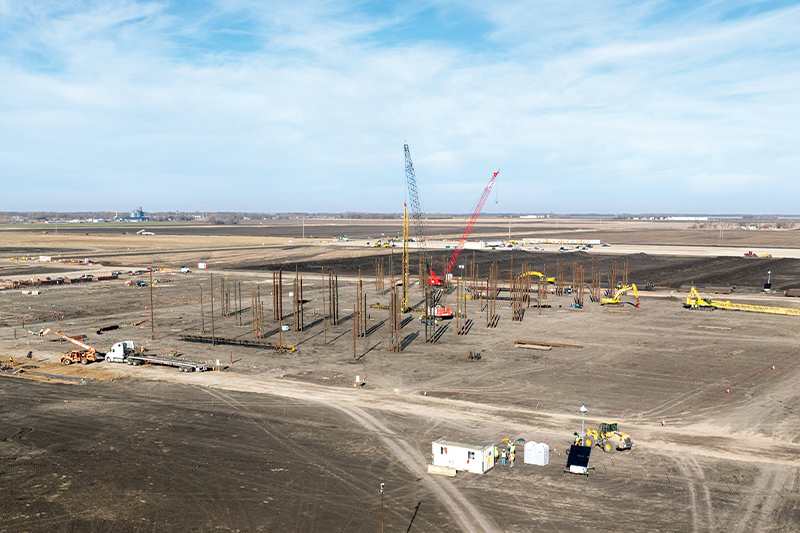
“Cass County Electric is proud to serve an AI data center, because it supports our core values of advancing innovation and strong commitment to our communities,” said Paul Matthys, president and CEO of Cass County Electric. “AI data centers are coming either way. We have an opportunity to embrace this technology here in North Dakota, where we can help secure data sovereignty and security, while also leveraging AI in weather forecasting, agriculture, health care and other important regional sectors.”
As Newman speaks to new classes of medical students, he’s learning that AI is now included in the curriculum as a tool to synthesize a medical information landscape that now doubles year over year. But knowledge is only the start of what AI can provide.
“I’m very optimistic that this is going to help patients and save lives,” Newman said. “Right now, with the huge workforce shortages we have, we don’t have another option but to leverage technology to get to all the patients in rural America.”
...

5301 32nd Avenue South
Grand Forks, ND 58201
P: 701-795-4000
