

Blazing a trail for wildfire mitigation
Minnkota has begun implementing its first formal Wildfire Mitigation Plan, a blend of proven protocols and enhanced strategies.
In the Upper Midwest, people experience wildfires in an often-disconnected way. North Dakotans and Minnesotans speak of smoke from Canadian forest fires stretching a haze over their summer months. When 2025 wildfires devastated communities in Los Angeles County, California, those living nearly 2,000 miles away could only sympathize with the families who lost their homes and livelihoods.
Wildfire is usually a problem happening elsewhere. But it can happen anywhere.
In late 2024, Minnkota Power Cooperative kicked off a conversation on how to prevent situations like these from happening within its transmission footprint. That conversation would turn into the cooperative’s Wildfire Mitigation Plan, approved by the board of directors one year later.
“Within the utility business, wildfire has become a bigger issue. We’ve had our eyes on it from a risk perspective for quite some time,” said Minnkota Transmission Engineering Manager Wayne Lembke. “Understanding what we were already doing was the starting point, and then we built upon that to make an effective mitigation plan.”
Minnkota’s new Wildfire Mitigation Plan was drafted in 2025 in accordance with legislation passed during North Dakota’s 2025 legislative session requiring utilities to have one in place. The 24-page document first outlines wildfire risk factors in Minnkota’s territory and continues with the steps the cooperative takes to reduce the risk of wildfire ignition and spread in its system.

The goals of the Wildfire Mitigation Plan go beyond complying with state law and limiting legal liability in the case of a fire.
“Two of Minnkota’s core values are safety and reliability,” said Shawna Setter, Minnkota vegetation management specialist and Wildfire Mitigation Plan coordinator. “In creating this plan, we’re increasing safety and reliability throughout our system and for our members, our communities and employees – everybody.”
Gathering the kindling
When it was time to start on Minnkota’s plan, Setter knew it would be crucial to get as many stakeholders in the room as possible, including those from Safety, Power Delivery Operations, Power System Operations and Engineering.
“We don’t know everybody’s day-to-day work, so getting everybody else’s perspective on how things are done out in the field was very helpful,” she said. “It takes an army. There are a lot of aspects of creating and implementing a plan, so it takes everybody to help mitigate fire risk.”

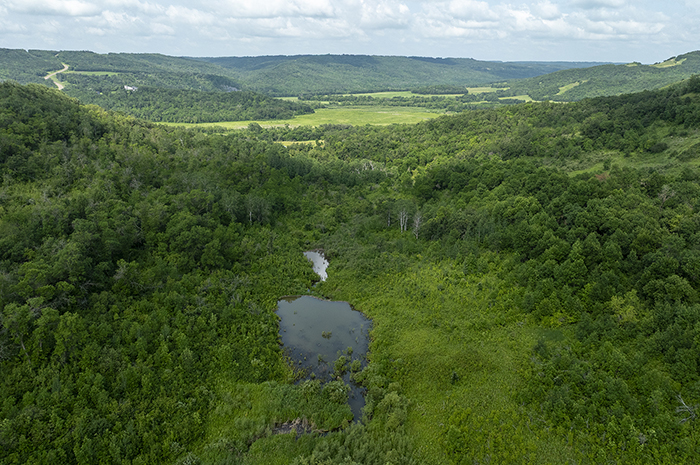
Once all departments were on the same page about the needs of the Wildfire Mitigation Plan, Setter set her sights on researching the wildfire risks of Minnkota’s transmission territory, which stretches from the Milton R. Young Station near Center, North Dakota, all the way east to International Falls, Minnesota. The region is diverse, from flat grasslands to thick forests.
Assessing risk can be difficult. A wildfire can happen anywhere during any season. However, Setter explained that by examining where wildfires have occurred in the past, and cross-referencing that historical risk with the region’s topography, drought prevalence and vegetation types, she can get a good feel of wildfire potential.
“The wildland urban interface is also a key tool, because it shows you where forested regions intersect with populated areas and can cause the greatest wildfire impact,” she said. “It’s a significant factor in identifying risk.”
After a risk analysis of the region – which indicates low wildfire risk across the majority of the footprint – the Wildfire Mitigation Plan clearly lays out the processes and procedures Minnkota follows to mitigate any potential risk, from operational practices and construction standards to infrastructure inspections and vegetation management.
“Improper vegetation in our transmission corridors is both an ignition risk and a burn risk. It can start the fire, and it can also cause the fire to persist depending on how we maintain our rights of way,” Setter said.
“For engineering, the mitigation focus is twofold. One is on the safety side, knowing that our equipment is designed properly so it’s not the ignition source,” Lembke added. “At the same time, if there is a wildfire, we want to be able to be resilient through that. When we’re designing projects in areas that are higher risk, we’re looking at using steel structures or ductile iron instead of wood.”
Heating up
Although Minnkota has always followed strong fire mitigation practices, drafting a formal plan allowed the team to expand upon its procedures to include new technologies and changes in industry standards. As a part of the plan’s full implementation, wildfire mitigation training for crews, contractors and other stakeholders will be enhanced, as will community outreach and education on wildfire prevention.
Throughout the process, Minnkota collaborated with other utilities who had already completed a wildfire mitigation plan, whether by state decree or internal proactivity. The collaboration will continue as Minnkota navigates its own plan’s first year of implementation. The plan’s authors have already been contacted by other utilities who are looking for guidance in writing their own plans, and they intend to pass the support forward.
“I think wildfire mitigation plans like this are going to become astandard,” Setter said. “It’s not just legislation that’s pushing it. Regulators like FERC (Federal Energy Regulatory Commission) and NERC (North American Electric Reliability Corporation) are starting to look at standards as far as wildfire mitigation goes.”
Wildfire mitigation plans began to develop heavily in California, a state prone to wildfire. But the idea has made its way from west to east and is now currently under discussion in the Minnesota state legislature as well. If passed, Minnkota will already be one step ahead with a plan in place – not only because it’s law, but because it’s the right thing to do.
“We want to make sure we’re never the ignition source out there, and if we are, we know how to handle it,” Lembke said. “One of our principles is concern for the community. This directly impacts our communities. We need to operate in a safe and reliable manner and not create an issue for our neighbors.”
...

5301 32nd Avenue South
Grand Forks, ND 58201
P: 701-795-4000
