

Cleaning up the concrete industry
Construction tool cleaner takes first place at Freeman Awards.
The winning idea at this year’s Andrew L. Freeman Innovation Awards didn’t come from a futuristic lab concept or a complicated theoretical problem.
It came from concrete stuck to a trowel.
Inspired by the everyday frustrations faced by construction workers, a team of University of North Dakota mechanical engineering students developed a portable ultrasonic cleaner capable of removing hardened cement from tools in seconds. The project captured the top award – and $3,100 — at UND’s annual senior engineering design competition on May 8.
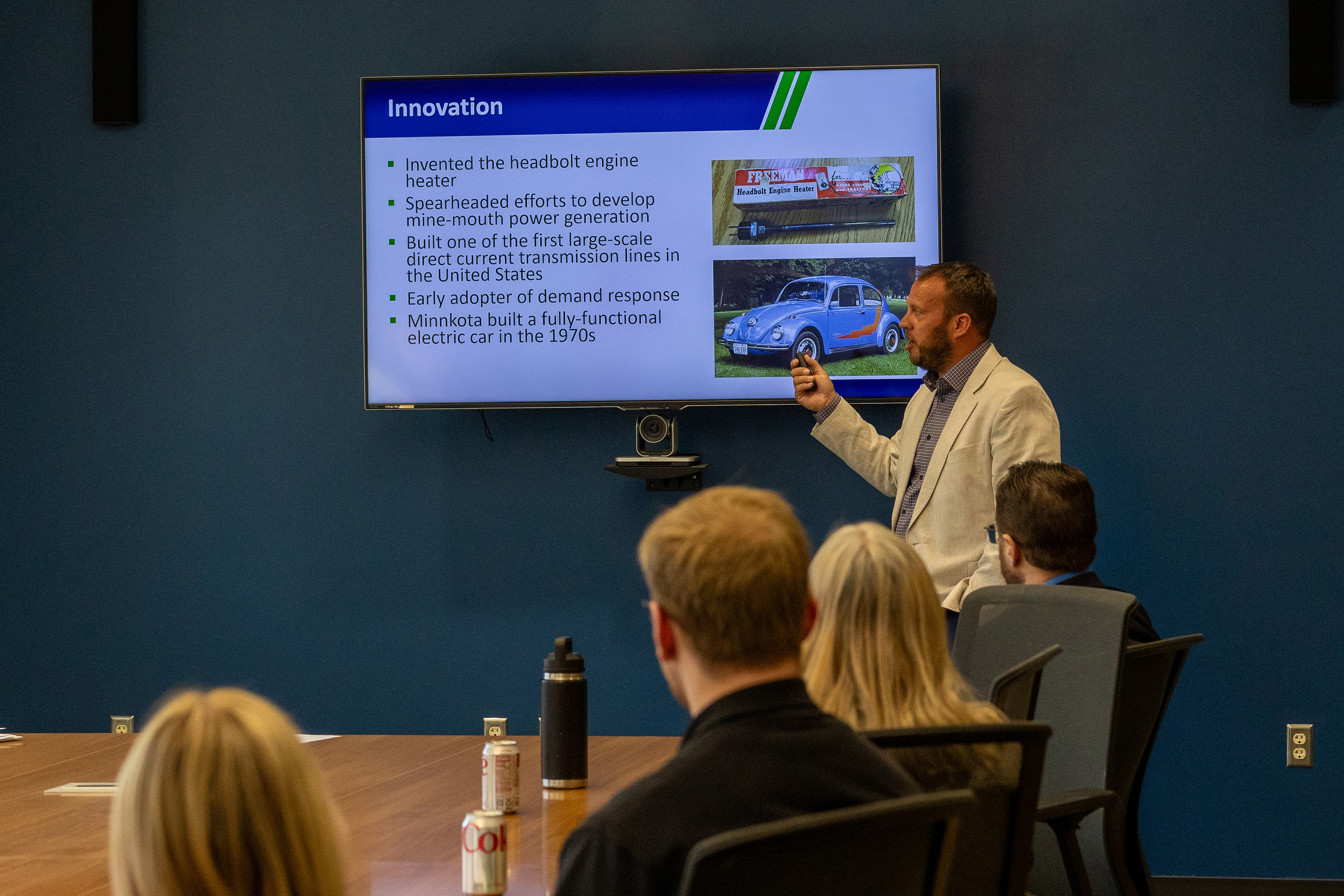
The competition honors the legacy of Andrew Freeman, a UND engineering alumnus, Minnkota Power Cooperative’s first general manager and a longtime innovator who helped drive the rural electrification effort across eastern North Dakota and northwest Minnesota. In addition to leading Minnkota from 1940 to 1982, Freeman also invented the Freeman Headbolt Heater, a device that helped vehicles and machinery start reliably during brutal winter conditions.
Since 2000, the Andrew L. Freeman Innovation Awards have recognized UND’s top senior engineering design projects, celebrating ideas that combine technical achievement with practical, real-world impact.
Kasey Borboa, Minnkota’s senior manager of power delivery engineering, served as a competition judge and spoke to students about Freeman’s legacy. Borboa said Freeman’s success was rooted not only in engineering and innovation, but also in working collaboratively.
“One of the most impressive things about these projects was seeing how the students worked together,” Borboa said. “There was a lot of creativity and technical talent on display, but the teamwork really stood out. The students leaned on each other’s strengths to solve difficult problems, and that kind of collaboration was a huge part of Andy’s legacy and successful engineering.”
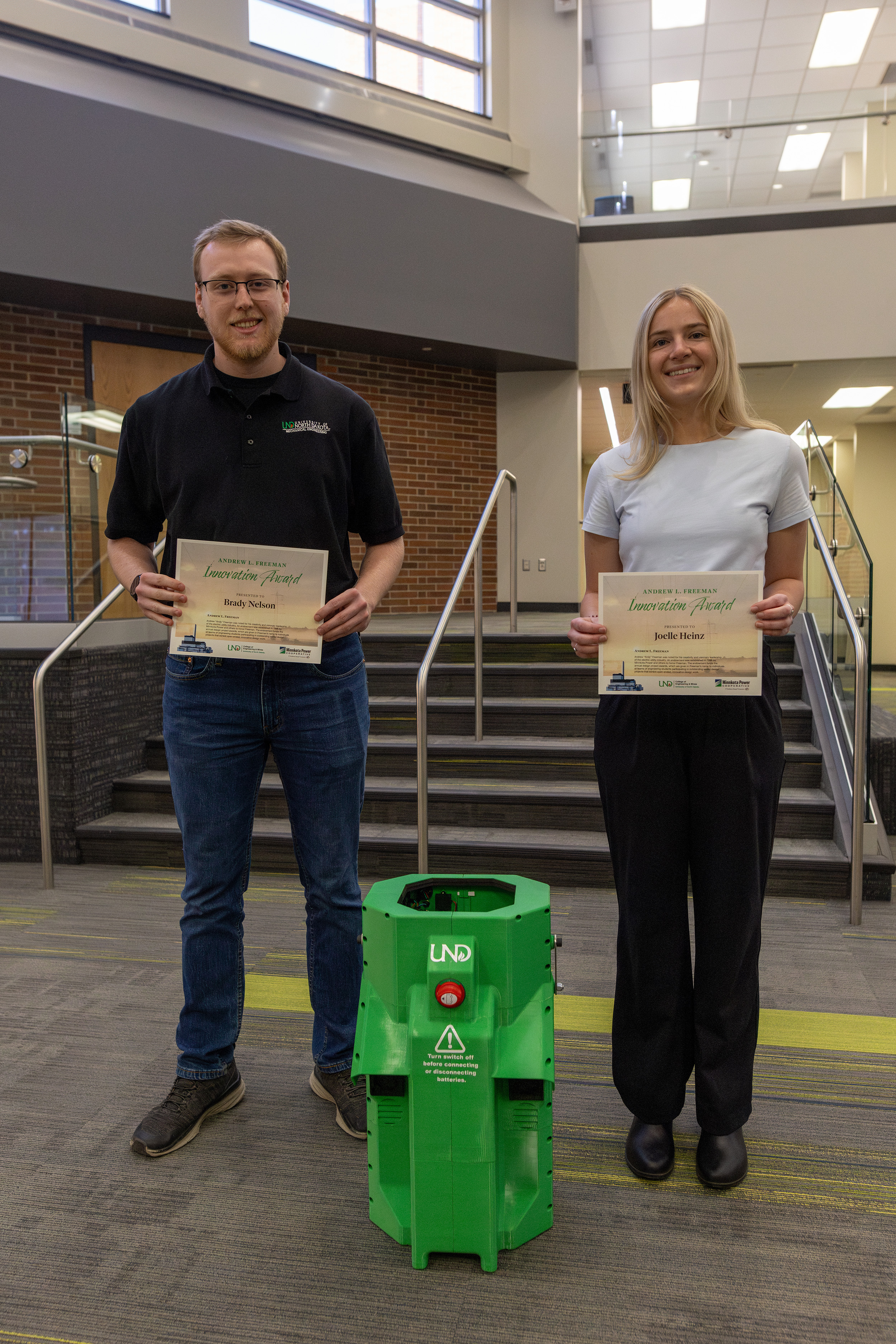
This year’s winning project was developed by UND students Brady Nelson, Joelle Heinz, Ethan Rasset and Matt Wahlers. The project concept itself came from local contractor Craig Knutson, who had experienced the problem firsthand on construction sites.
“Particularly on hot days when you have concrete that’s setting up quicker than you want it to, your tools are the last thing that you get to at the end of the day,” Knutson said. “A lot of times it can be insanely hard to clean a tool, and sometimes you just have to abandon it.”
The students’ goal was to create a portable system that could quickly clean concrete tools without requiring hours of scraping, soaking or harsh chemicals. From there, the team produced a fully functioning prototype designed specifically for the demands of construction work.
“Basically, there are these ultrasonic transducers that are mounted to the tank,” Nelson explained. “We apply power to those. It’s going to vibrate the tank, which puts pressure waves in the water and that creates these little bubbles that pop. It’s called cavitation. As those bubbles collapse, they generate enough force to break loose hardened cement stuck to submerged tools.”
The results were impressive. Freshly coated tools could often be cleaned in under 30 seconds. Even tools left dirty for extended periods were still cleaned effectively.
The portable design was another major breakthrough. According to the team, the system currently runs between 30 minutes and an hour on battery power depending on the cleaning cycle being used.
For the students, the project offered something different from traditional classroom assignments.
“It’s pretty cool to see something start from nothing and grow the whole year and see that the concept actually works and could potentially be a shelf product,” Heinz said.
The ultrasonic cleaner was one of several notable projects showcased during this year’s competition. The second-place entry came from UND chemical engineering students Madeline Vettel, Blake Kajewski and Aleece Devine, who developed a concept for producing boutique liquid hand soap from recycled cooking oil collected from Midwest restaurants. Their project explored the feasibility of transforming waste cooking oil into a profitable and environmentally friendly soap production process.
For Nelson, first place in the Freeman Awards served as validation for the team’s work throughout the year.
“It’s very special,” Nelson said. “I was very proud of the work that the team had done beforehand. We’ve gotten a few compliments from our professors and faculty advisors about how far this has come, and it’s very validating to be recognized externally for it as well. It’s a very proud moment for us.”
...
5301 32nd Avenue South
Grand Forks, ND 58201
P: 701-795-4000
