

Finding real humanity in artificial intelligence
The University of North Dakota is embracing AI as the future of education and societal problem-solving.
Anna Kinney understands the tension between higher education and artificial intelligence. In her previous role at the University of North Dakota (UND), she led the campus Writing Center, not only helping students, staff and faculty with their writing projects, but assisting in integrating strong writing practices across the university’s curriculum.
When AI writing tools went mainstream, Kinney’s friends and family began to voice concerns about her future at UND. But she didn’t necessarily see AI as a threat. She saw it as the next stage of education – and she was ready to help others see that as well.
“Writing teachers and writing scholars have long been thinking critically about the writing process in the face of technology. Even copy and paste was a scary moment for many,” Kinney said. “So, when ChatGPT dropped, writing scholars in our field had already been thinking deeply about AI. I was in a fortunate position, in my field and position on campus, to help support our colleagues as they started really grappling with what AI meant for their disciplines.”
Kinney now serves as UND’s AI Instructional Manager, a new role charged with building an AI-across-the-curriculum program. The position is thought to be the first of its kind in North Dakota, with a goal of assisting departments and faculty in thinking about what AI means specifically for their field and then creating appropriate curriculums to ensure that student learning is preserved.
This new focus on responsibly integrating AI into learning is just one facet of UND’s larger goal of not only embracing the promise of AI, but leading the state in AI education and research. Over the past two years, UND has introduced two new degree programs centered on AI: a Ph.D. in Artificial Intelligence and a graduate certificate in AI and Machine Learning. At his State of the University address in 2025, UND President Andy Armacost proclaimed that UND would become “North Dakota’s artificial intelligence university.”
“There’s no better place to have the discussions about the technology, and what its impact is on our humanity, than at the University of North Dakota,” he said during his August speech. “We have the people who are interested in these discussions across all disciplines. We want all our students to have these tools, but they should also have skepticism about abandoning their human responsibilities.”
AI across campus
Humanity has become the heart of UND’s AI leadership. Although the technical learning behind AI is crucial and supported through degree programs and courses, UND is also seeking solutions to two large questions: How do we retain the strengths of humanity in an era of AI? And how can we leverage AI to help people?

On March 20, UND’s AI and Human Innovation Initiative (co-chaired by Kinney and UND Theatre Arts Department Chair Emily Cherry Oliver) hosted its second annual AI showcase, an opportunity for students, faculty, staff and the greater community to come together for a discussion of AI and celebrate the interdisciplinary AI-related work of those across campus. The event began with keynote and panel discussions, followed by a poster and digital exhibit of more than a dozen student and faculty research projects combining AI with fields like education, law, medicine and engineering.
“Our hope is that this showcase creates more conversations and collaborations between UND and the community, and also that it creates more innovation within North Dakota,” Cherry Oliver explained from the wings of the event’s exhibition floor. “President Armacost has made this the year of humanity in AI, which very closely aligns with what the initiative is trying to do. He's really challenging all of us to think about not just the multi-uses of AI, but about who we are as humans, as artists and as thinkers within the AI sphere.”
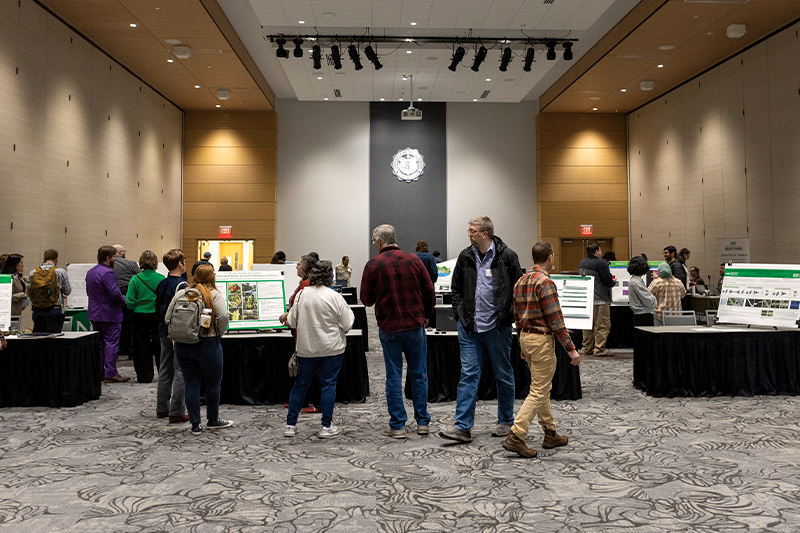
UND has taken interdisciplinary AI research a step further with the formation of the Artificial Intelligence Research (AIR) Center. The center has many goals, including developing cutting-edge AI solutions to solve complex problems, training the next generation of AI researchers, promoting ethical standards in AI and fostering partnerships with multiple sectors. But according to Dr. Naima Kaabouch, UND professor and AIR Center director, all these goals boil down to one core objective.
“The objective is to help humanity – to bring real benefits to people,” said Kaabouch, who joined UND as faculty 20 years ago and has since become a campus authority on AI, cybersecurity and autonomous systems. “The Center has several leads and students, staff and faculty, all interested in using AI to solve real-world problems.”
While engineering applications of AI are central, the AIR Center also serves as an umbrella for important AI work happening across eight research areas: fundamental AI models, autonomous systems, cybersecurity, infrastructure inspection, biology and medicine, physics and chemistry, aerospace and aviation, and education and social sciences.

Kaabouch spoke of key research underway in the AIR Center that would directly impact North Dakotans, including using AI to enhance power grid security, train K-12 teachers, and more quickly and accurately predict severe weather and flooding.
“We have flooding every year in North Dakota,” she said. “I have had online students in the past tell me, ‘I can’t meet today because my farm is flooded with water.’ So, we want to predict how the flood will progress so people can take action.”
The AIR Center has also reached out to departments at North Dakota State University in hopes of collaborating on AI research specific to agriculture. Connections have already been formed with entities around the state, and even around the country, for the sake of strengthening society with AI.
“If you look at every field, every sector, you can see that AI can speed up progress and find a better way of doing things,” Kaabouch said. “By doing great work and helping the state and the country, we are highlighting the quality of research UND is doing. We have a great team, all trying to use AI in their field.”
UND realizes that the idea of AI in education isn’t just one thing. It isn’t simply creating an AI use policy or offering an AI fundamentals course. It’s taking a holistic look at AI, the ethics behind it, the possibilities it creates and how it can be used to bring out the best in us.
“I think that one of the things UND does really well is create community, and I think that that will remain central regardless of how AI changes,” Kinney said. “We lead with our people, and I really believe that will be our greatest strength as we continue to move forward as people who are willing to ask the questions, lead with their values and just never lose sight of the purpose of what we're doing here.”
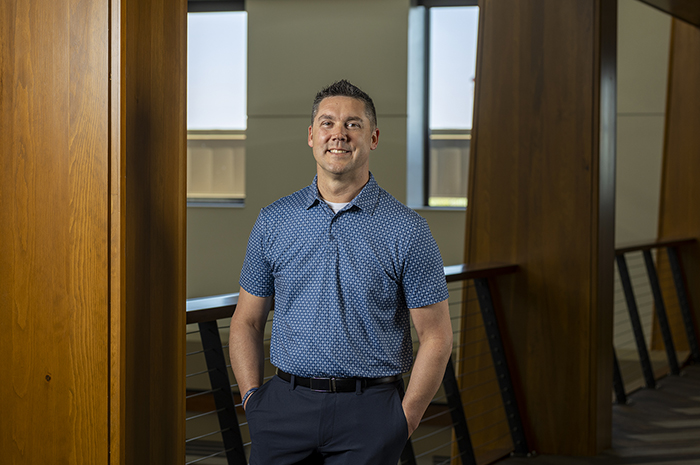
MAIN IMAGE: Anna Kinney is the AI Instructional Manager for the University of North Dakota, a new role on campus. (Minnkota/Michael Hoeft)
...
5301 32nd Avenue South
Grand Forks, ND 58201
P: 701-795-4000
