

Seeking stability in market volatility
Minnkota’s energy marketing team serves as the first defense against price fluctuations in an increasingly tricky energy market.
Participation in the regional wholesale energy market can be a white-knuckle thrill ride.
Gone are the days of predictable pricing and casual assessments of wind reports. When Dan Trebil started in energy marketing at Minnkota Power Cooperative 13 years ago, his workdays, even weeks, were mostly docile. In 2026, as the co-op’s senior manager of Energy Supply, his crew of energy marketers is working to tame a wild beast that keeps getting wilder.
“The difference is night and day,” Trebil said of the current volatility of the Midcontinent Independent System Operator (MISO) energy market. “We spend a lot more time now looking at wind forecasts than we used to, and this team collaborates with just about every department in the building.”
Minnkota’s Paige Johnson began her career in energy marketing four years ago. “In the last two years especially, the pace has really amped up,” she said. “There’s so much to pay attention to in every avenue. All the transmission projects coming through and the market going crazy – you have to be very present in the energy marketer role.”

The energy market – or the system through which utilities buy or sell energy across the regional electric grid to balance generation with demand – has become more volatile for several reasons. The dominating factor is the retirement of reliable power plants and their replacement with weather-dependent generation resources across the MISO footprint, which stretches from Manitoba, Canada, down to Louisiana. This major resource transition is happening at a time when the demand for electricity is forecasted to grow significantly.
“Ten years ago, the majority of resources on the system were reliable, baseload, dispatchable generators. They used fossil fuel, but they could be controlled. You could run them up and down as needed with demand,” Trebil explained. “With wind and solar generators, you’re at the mercy of Mother Nature.”

As wind and solar are added to MISO’s capacity, they increasingly drive market pricing. On days filled with wind and sunshine, energy is typically readily available. On days that are either still or cloudy, pricing can reach extreme highs.
“An example of where we start to see a lot of volatility is with solar penetration,” Trebil said, noting that solar panels stop producing quickly when the sun drops in the evening, which also happens to be the time demand rises as people arrive home. “When solar bleeds off, it’s currently difficult for the market to respond with resources that can ramp up quick enough to mitigate that swing.”
Transmission congestion is also impacting market volatility. There are currently more bottlenecks in the transmission system because of MISO’s changing resource mix and growing loads across the system. Thus, more pathways from generation to end-user are needed. MISO member utilities and participants are investing historic amounts into building out more transmission, but that buildout will take many years to complete.
Amid all of this, MISO knew stronger price signals were needed to ensure its participants were planning their resources appropriately. In April 2025, MISO increased its maximum energy price threshold from $3,500 per megawatt-hour (MWh) to $10,000/MWh. For comparison, rates during stability hang around $20-50/MWh.
Protection from market exposure
If Minnkota needs to buy power during periods of extreme market volatility, the financial impact can be significant. For instance, being short 400 MW and purchasing replacement energy at peak prices for just four hours would cost about $16 million. If those conditions persist, the total cost can climb quickly, creating a substantial financial burden.
To prevent that exposure, the energy marketing team has to plan ahead.
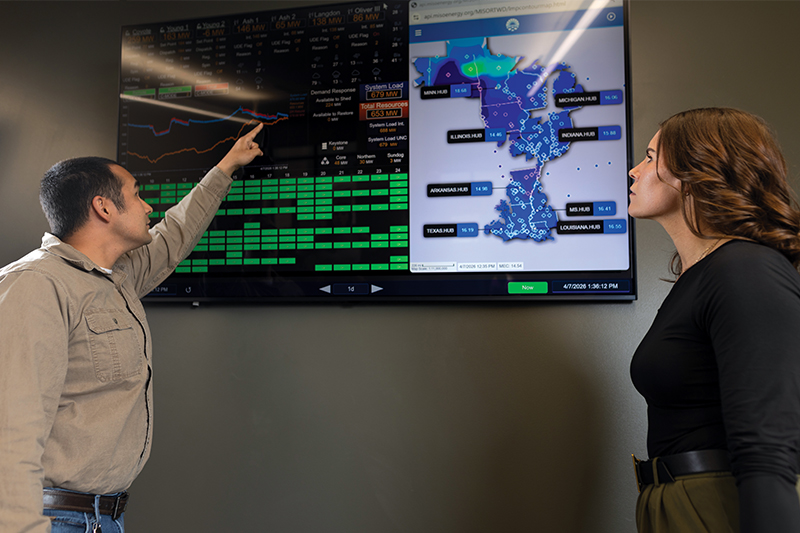
“In our daily schedules, we pay particular attention to those two hours other utilities are losing solar to be extra careful,” Johnson said. “We might bump up our load a little bit so that we're long in the real-time market, or we’ll be cautious with our wind expectations if we're not 100% sure that it's going be there.”
“We can mitigate some risks in the day-of market. But if you have a plant trip offline, or something similar, you're still exposed during that timeframe,” Trebil added. “That's where having demand response in your back pocket really becomes valuable.”
Minnkota’s demand response program allows the co-op to shed nearly one-third of its load when necessary. The program is popular with its volunteer member-consumers, who sign up and receive lower electricity rates in return. The program has been essential in protecting Minnkota from high market prices when demand is high across MISO (like during a long cold snap) or when generation is lower than expected (minimal wind or plant outages).
MISO continues to explore ways to alleviate extreme market swings, but there’s no one easy fix. In 2023, the operator switched from an annual to a four-season peak demand resource adequacy construct. This aligned needed generation capacity with shifting seasonal risks (peak demand usually occurred in summer, but is now shifting to the winter season as well). In 2025, MISO enacted a reliability-based demand curve, which has helped to provide more accurate values for additional capacity. Even more reforms are being assessed for the years ahead.

Minnkota is also exploring additional measures of its own, including the analysis of new generation resources that could raise regional baseload generation capacity and strengthen its all-of-the-above energy strategy.
Of course, one of the most powerful arrows in Minnkota’s quiver will always be the exceptional range of its people. Trebil and his energy marketing team will continue to meet every morning, on chaotic days and quiet ones, to ensure the co-op is protected from volatility at every angle.
“We have a great group of people,” Trebil said. “We've gathered a good diversity of skills. I think each one of them has a different element they're very strong at, and that makes them a good team.”
MAIN IMAGE: Minnkota Energy Marketer Dylan Walski (left) leads a team discussion on current energy pricing in the Midcontinent Independent System Operator market. (Minnkota/Michael Hoeft)
...



5301 32nd Avenue South
Grand Forks, ND 58201
P: 701-795-4000
