

A high-voltage high-wire act
Minnkota recently leveraged an airborne linework partner for a series of transmission line reliability projects.
Wind and wheat.
North Dakotans are accustomed to an abundance of both in the late summer season. The combination creates a visual effect that early American patriots wrote songs about – amber waves of grain, and all.
But when you’re hovering a helicopter within spitting distance of an energized 345-kilovolt (kV) transmission line, with your teammate actively adding equipment to the hot conductor, a wave through the amber grains means a wind gust. And wind gusts are bad news for chopper blades.
It’s a good thing George Denton is a seasoned utility pilot for HLH Aviation, the company Minnkota Power Cooperative contracted to assist with a July through October maintenance and outage mitigation project on one of its largest transmission lines. Denton flies for jobs like this all over the country, but the Red River Valley proved to be a challenge.
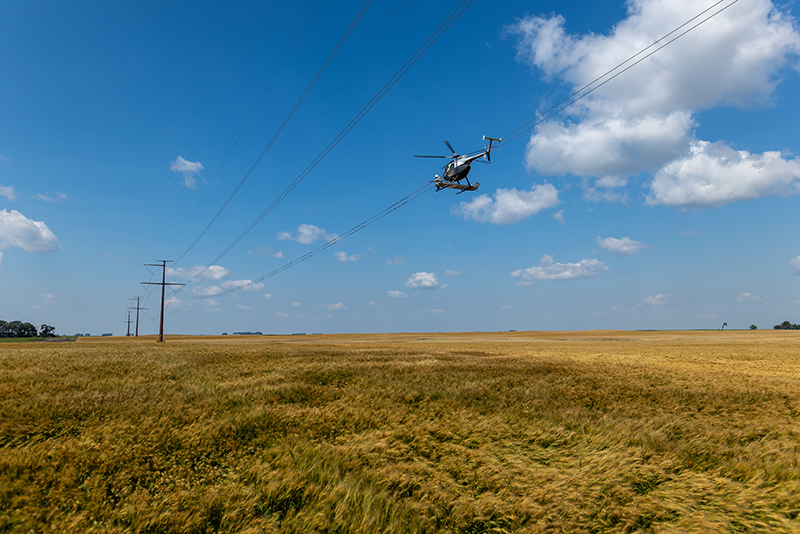
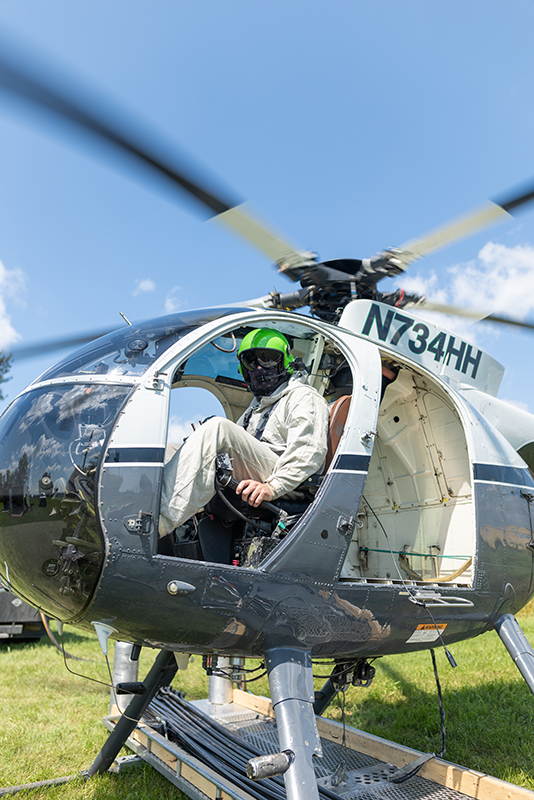
“Minnkota has been good to us, but North Dakota has not been good. It’s flat and windy,” he joked after pulling off his flight helmet for a break. The pilot and his crewmate had just set down in a rural landing zone near Aneta, North Dakota. They had to change their flight plan for the day due to a change in wind direction. “We’d be fighting a crosswind, and the aircraft doesn’t like it.”
HLH Aviation’s precision, experience and airborne equipment made them a perfect collaborator for the first phase of Minnkota’s four-year project to improve reliability on the 250-mile transmission line that runs from Center to Grand Forks, North Dakota. The initial phase focuses on the 80-mile span from Binford to Grand Forks and will continue to the west in the years to come.
Power over the wind
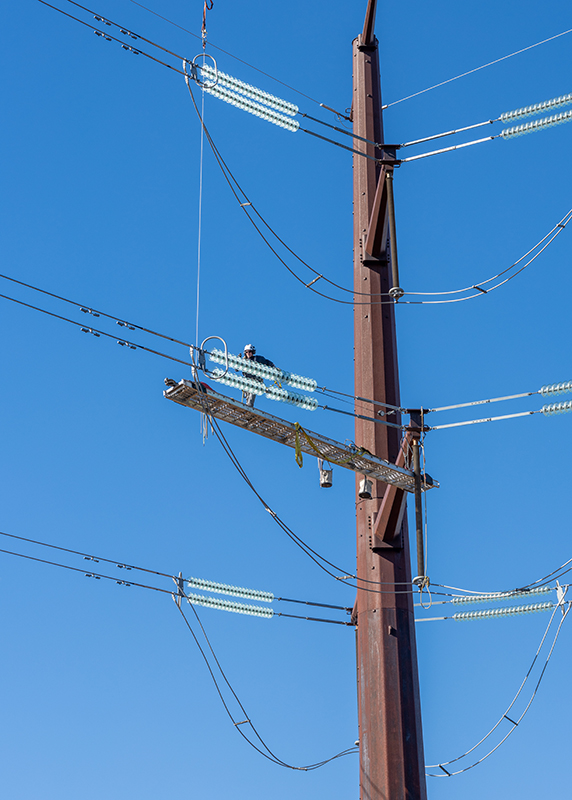
In the first months of the project, HLH performed “hot work,” floating more than 100 feet off the ground to add airflow spoilers to the energized 345-kV line. The airflow spoilers, 16-foot plastic spirals, wrap around the conductor at 15-foot intervals. This creates a profile that makes it difficult for ice to form on the line.
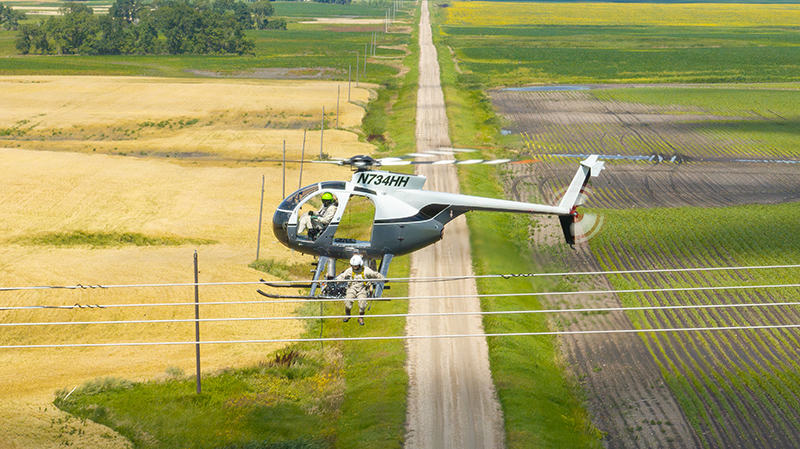
“When ice forms, it can create an airflow like an airplane wing. And that’s one of the main mechanisms for galloping lines in the wind,” explained Brenden LaHaise, Minnkota transmission engineer. “That’s what gives it the lift to start to move, and that motion can get violent and cause outages.”
In addition to 20 miles of airflow spoiler placement, HLH took advantage of a multiweek planned maintenance outage at Minnkota’s Milton R. Young Station to perform additional work on the line while it was de-energized. During that time, three helicopter crews installed new phase vibration dampers to mitigate aeolian vibrations. This kind of vibration occurs as wind flows over the phases and, over time, can cause damage to the arms or other structural components. Finally, the crews took care of some general maintenance while aloft, such as changing out broken glass insulators.
Over just four months, the helicopters completed work that would have taken Minnkota much longer from the ground.
“For the airflow spoilers alone, we would have to drive, put one or two on, and then drive another 30-40 feet, put more on, and keep going,” LaHaise said. “That would get excessively monotonous, and we’d be burning up a lot of time doing it. These helicopter crews can just float and put them on as they go.”
Damage to land would also become a consideration, as larger equipment would be needed to reach the 100- to 150-foot-tall lines.
“Some of this 345-kV line is in less-than-ideal terrain,” said Minnkota’s Jake Beckel, the project’s construction coordinator. “It doesn't run right along a road like a lot of our 69-kV system does. It's very cross country.”
“The helicopter doesn't care about that,” LaHaise added.
'Copter kinship
HLH Superintendent of Line Operations Caden Callaway has been flying with pilot George Denton for several years, executing airborne power line projects across the country. They’ve built a mutual confidence that strips away any fear of heights.
“I mean, I’m aware of it,” said Callaway in his slight Southern drawl. “But you just make sure you’re tied off and you trust in your equipment. One of the biggest things is trusting the pilot, and once you have that down, you’re fine.”
Aerial linework isn’t for the anxious. Lineworkers often dangle from benches or harnessed chairs as they fly to a site, relying fully on the pilot’s steady hand to maintain balance as they perform intricate tasks on the line. On top of the daredevil work itself, the HLH Aviation crew is constantly on the move from one state to the next to help utilities like Minnkota with their toughest jobs.
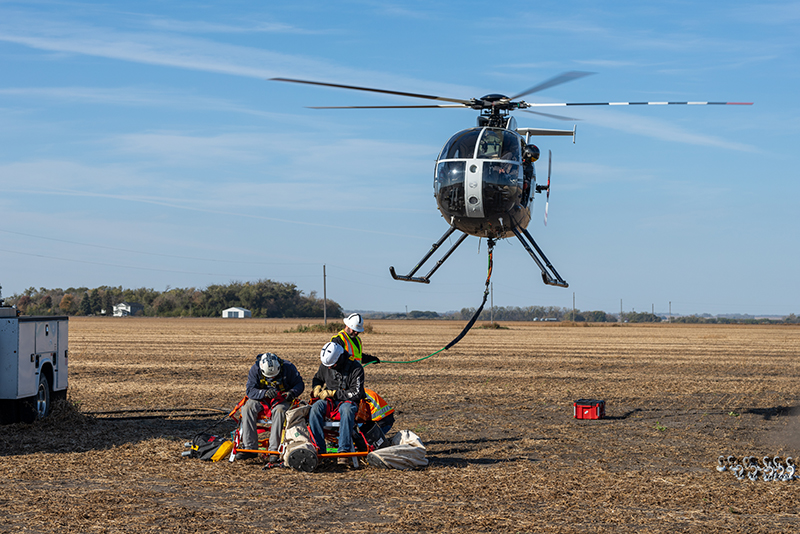
“I’m around these guys more than my wife and kid. Which is hard,” said Callaway, who just welcomed a baby boy this year. “But the main thing that keeps me going, especially in my position, is just getting the next guys up and ready to go and making sure everybody's safe.”
As much as the North Dakota wind proved to be troublesome for his crews, there were some qualities of the area that worked in their favor. For example, Callaway personally experienced North Dakota Nice several times while finding on-the-fly permission for landing zones.
“I just pulled into a driveway and started talking to somebody, and you would've thought I was their neighbor for the last 20 years,” he laughed. “I ended up having to tell him, ‘Hey, I gotta go to work, but it’s been great talking to you.’”
The HLH team concluded their work before the start of November but will likely be back for future phases of the 345-kV project. And now it won’t just be the wind and wheat welcoming them.
“That's a great thing about North Dakota,” Callaway said. “There are plenty of wide-open places, a lot of options. Especially with everybody being so friendly.”
MAIN IMAGE: An HLH Aviation crew hovers beside a 345-kilovolt transmission line near Aneta, North Dakota. (Minnkota/Michael Hoeft)
...

5301 32nd Avenue South
Grand Forks, ND 58201
P: 701-795-4000
